Negative Insulin on Board - and What it Tells Us
In this post I explain what negative IOB is, and what it can tell us about our hybrid closed‑loop system.
Disclaimer: I’m not a medical professional. This content is for informational purposes only and should not be taken as medical advice. If you are unsure about anything, consult a qualified healthcare professional.
This post assumes that the reader has a (DIY) loop system. While it does contain information that is useful for all diabetics, some parts are only relevant to loopers.
First some basal knowledge (pun intended)
As I often find myself doing when explaining something, I first need to give some context. To understand Insulin On Board (IOB) we need to know what basal insulin is. Basal is the baseline amount of insulin a person needs to keep their blood glucose (BG) level steady. I think of it as a background requirement of insulin just to keep the body functioning without other outside influences such as exercise or food. In this article I am exclusively talking about short acting basal given by an insulin pump.
What Insulin On Board is
IOB is a metric that loop algorithms use to steer our BG. It is the amount of insulin delivered on top of basal that is still active at this point in time. We can write it as such:
Net IOB = absolute IOB - programmed basal
Where absolute IOB is the total amount of insulin in the body, including basal. This is an important nuance, because the total amount of insulin in the body can never be negative. (And while we’re at it, let’s try to keep it above zero as well, because prolonged insulin deficiency can cause a nasty case of Diabetic Ketoacidosis (DKA)1).
The reason we use two different kinds of IOBs is quite a technical one which is out of scope for this post, but you can find more about it in the footnotes.2 From now on, when I use IOB, I mean net IOB.
What negative IOB means
Simply put: A negative IOB means that at this point in time there is less insulin delivered than scheduled in the basal profile.
Now we know what negative IOB means we can look at a few examples:
Example number 1: Swimming pool with disconnected pump
We have a tubed pump and are at a swimming pool. We don’t want to go low, so we thought ahead and bolused less for our last meal. The pump is not watertight so it has to be disconnected. After 2.5 hours of fun we check in to see how we’re doing.
Since we didn’t get any basal for the last 2.5 hours and the last meal bolus was smaller and a while ago, we see our IOB is negative. Because we were active, our BG almost dipped low but is now climbing back up.
In this case a negative IOB is expected and the reason behind it can be easily understood. After all, we didn’t get any insulin for a couple of hours. The fact that it is expected however doesn’t mean that it is harmless! When exercising and disconnecting our pump we walk a fine line between insulin sensitivity and the onset of DKA. DKA is caused by a lack of insulin (hypoinsulinemia), not high blood sugar which is often thought. High blood sugar is also caused by a lack of insulin and while it very often accompanies DKA – and can amplify it through dehydration – it’s not always present. (Looking at you, hot mountain climbing trip!).
Example number 2: Night Sweats
We wake up in the middle of the night, soaked in sweat, sensor blaring. Great, a hypo. When we look at our loop, it looks something like the below screenshot I took from my nightscout site (although mine shows 2 hypos, the first one was a compression low3 and I slept through both… Oops).
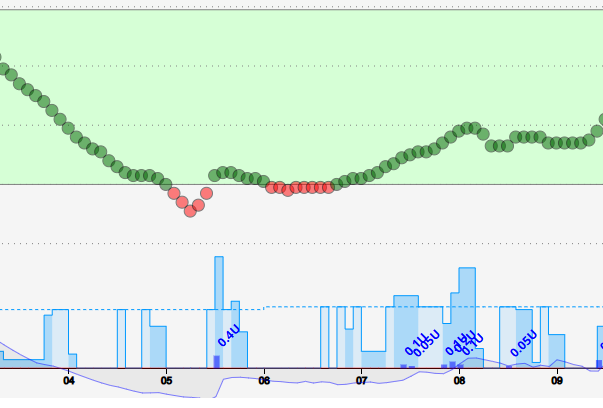
What makes this an important example is how the loop behaves once IOB goes negative (shown as the blue IOB line going below the axis). If the loop fails to prevent a hypo while it lets IOB go negative, it is a sign that it did not sufficiently detect/respond to sensitivity. Another option is that it is settings related, but more on that in example 3. For this example we’re assuming an isolated cause of sensitivity.
Because the IOB is negative (below basal levels), the loop thinks there is an insulin deficit that needs to be corrected as soon as there is an opportunity to do so. As can be seen in the image at 05:30, when it gave me a micro bolus of 0.4U. The loop behaves like this because our basal profile tells the loop that’s the minimum required amount the body needs, so it wants to correct.
If we were to eat some carbs to correct the low (and not sleep through it) the loop would predict that our BG would go up. But because it is not sufficiently aware of our sensitivity, it overestimates the expected rise and starts ‘backfilling’ the insulin that it thinks we are missing. This often results in repeated hypos and it looks like the loop is stuck in an aggressive cycle.
The solution to this would be to correct the hypo and take some extra carbs that we don’t tell the loop about. The amount of carbs would approximately correspond to the amount of negative IOB. For example: if we have -1u IOB and an insulin to carb ratio of 5:1, we take ~5 extra carbs. This gives the loop the opportunity to resolve the negative IOB without sending us into another hypo, breaking the cycle.
Example number 3: Repeated negative IOB during the same time of day/week
When we notice a pattern of negative IOB (with or without a hypo) it is an indication that it is settings related. But which setting could it be? That depends on the circumstances, and could also well be a combination of settings. Below are listed some situations and what corresponding settings I would look at with explanations of why:
Settings to check and why
Does it happen only after a meal (High Carbs On Board (COB))?
Look at the Insulin to Carb
(I:C)ratio. –> More likely meal bolus related.
Does it happen only after a BG correction bolus (High IOB)?
Look at the Insulin Sensitivity Factor
(ISF). –> More likely correction bolus related.
Does it happen after both of the above?
Loot at both ISF/I:C –> it could be either, but only ever change one setting at a time!
Does it happen during fasting conditions (Low COB and IOB)?
Look at the Basal Profile.
Also see if the Duration of Insulin Activity
(DIA)4 is set correctly because DIA also applies to basal insulin. –> Unlikely I:C or ISF because of fasting.
Summary
Negative IOB can be tough to understand at first because it is influenced by many aspects of diabetes management. I hope this post helps demystify it a bit and provides tools to better understand what’s going on with your or your loved ones’ diabetes.
-
Diabetic Ketoacidosis is a dangerous condition that happens when the body doesn’t get enough insulin. The body switches to a quick and dirty fat burning process that releases ketones. Those ketones build up in the blood and can make it acidic. If left untreated DKA can be life-threatening. ↩︎
-
To summarize it has to do with a loop being a control system and control systems benefit from having a ‘control variable’ that can go in both directions of deviation. ↩︎
-
A compression low is a false low reading from a glucose monitor that happens because the wearer lays or leans on it, compressing the tissue around it. This alters the measurement in such a way that the sensor thinks the BG is low. ↩︎
-
Duration of insulin activity or DIA is a setting that tells the loop how long it should assume it takes insulin to finish acting on the body. It influences how fast IOB is counted down by the loop. It alters the length of the activity curve but does not change the total area under the curve (the insulin’s total effect). Lower DIA means IOB decreases faster, allowing the loop to deliver more insulin sooner. If DIA is set too low, a bolus may still be acting to lower BG even though the loop shows no remaining IOB. It is recommended to not change this from the default that the developers have set it to, unless you know what you are doing! ↩︎